SACRED STORIES AND SACRED PLACES OF THE MIDDLE EAST: EGYPT, JORDAN AND JERUSALEM


QUESTIONS AND PRIORITIES

My three biggest concerns for this trip are the cost, the heat and the pace.

1)  Can we put together a package that is affordable for students and that provides them with a rewarding educational experience for fair value?

2)  How hot will it be and what impact will this have on the entire trip?  How should concerns here influence planning?

3)  How can we best strike an effective balance between visiting a range of different places and moving at a pace that does not qualify as frenetic?


I.  SUGGESTED ITINERARIES

A.  Roundtrip To Amman Option

Comments

This alternative itinerary would feature a landing and very short stay in Jordan; a few days in Jerusalem; the move southwards for an extended visit to Egypt; and a return trip to Jordan for a more extensive tour of that country before moving on to either the dig or the Comox Valley.  The potential benefits include a somewhat less overwhelming beginning to the trip with a day or two in Madaba and then an introduction to Jerusalem versus the double whammy of an arrival in Cairo and the train trip southwards.  The disadvantages include adding some extra miles to the itinerary and perhaps added challenges in finding an appropriate Egypt/Jordan/Jerusalem balance.

A Possible Itinerary

[Flight to Amman ( 2 calendar days)]

Day 1:  Flight to Amman

Day 2:  Arrival in Amman and transfer to Madaba

[1 Night in Madaba]

Day 3:  Day Trip Excursion From Madaba

[4 Nights in Jerusalem]

Day 4:  Travel to Jerusalem

Day 5:  Jerusalem Day Trip

Day 6:  Day Trip Excursion From Jerusalem

Day 7:  Guided Jerusalem Tour

[2 Nights in Cairo]

Day 8:  Travel to Cairo

Day 9:  Cairo Day Trip

Night Train To Aswan

[1 Night in Aswan]

Day 10:  Aswan Free Day

[2 Nights on a Felucca]

Days 11-13:  Sailing the Nile

Day 13:  Travel from Edfu to Luxor

[4 Nights in Luxor]

Day 14:  Luxor And The West Bank:  The World Of The Pharaohs

Day 15:  Luxor Day Trip

Day 16:  Option

a)  The West Bank:  The World Of The Nobles And The Artisans

or b)  Free Day In Luxor

Night Train from Luxor to Cairo

[3 Nights in Cairo]

Day 17:  Egyptian Museum

Day 18:  Guided Cairo Tour -- Islamic Cairo

Day 19:  Guided Cairo Tour

[2 Nights St. Catherine's Monastery]

Day 20:  Cairo to Saint Catherine's

Day 21:  St. Catherine's

[2 Nights Aqaba]

Day 22:  Travel from St. Catherine's to Nuweiba to Aqaba

Day 23:  Free Day in Aqaba

[3 Nights Petra]

Day 24:  Guided Tour

Day 25:  Option

a)  Exploration of Wadi Rum with possible overnight stay in desert

or  b)  Free Day in Petra

Day 26:  Independent Exploration of Petra (including optional night-time entry)

[2 nights Madaba]

Day 27:  Day Trip and Travel to Madaba

Day 28:  Day Trip Excursion From Madaba

Day 29:  Return from Amman to Comox Valley


B.  Cairo Arrival -- Amman Departure

Comments

Regardless of whether or not we land in Cairo, we will need to answer a number of questions in regards to the Egypt portion of our tour.  These include the following:

  • How much time do we want to spend in Cairo?

  • Should we travel all the way to the south of Egypt?  If we go down the Nile from Aswan to, for example, Edfu, what are the different options here and the attendant time frames?

  • How many days should we spend in Luxor?

  • Is it possible to travel north of Luxor to Abydos and Amarna?

  • Should we visit St. Anthony's and/or St. Paul's Monastery in the Eastern Desert and, if so, how can this best be fit into the itinerary? 

  • Should we visit St. Catherine's and how can it best be fit into the itinerary (overland from Egypt? by water from Egypt? by water from Jordan?)

[Flight to Cairo( 2 calendar days)]

Day 1:  Flight to Cairo

[2 Nights in Cairo]

Day 2:  Arrival in Cairo

Day 3:  Bus Tour of City and Overcoming Jet Lag

Night Train To Aswan

[1 Night in Aswan]

Day 4:  Aswan Free Day

[2 Nights on a Felucca]

Days 5-7:  Sailing the Nile

  • Kom Ombo

  • Edfu

Day 7:  Travel from Edfu to Luxor

[4 Nights in Luxor]

Day 8:  Luxor And The West Bank:  The World Of The Pharaohs

  • Temple of Hapshepsut

  • Colossi of Memnon

  • Ramesseum

  • Valley of the Kings

  • Karnak

Day 9:  Luxor Day Trip

  • Abydos

  • Dendera or El-Amarna

Day 10:  Option

a)  The West Bank:  The World Of The Nobles And The Artisans

  • Tombs of the Nobles

  • Deir El-Medina

or b)  Free Day In Luxor

Night Train from Luxor to Cairo

[4 Nights in Cairo]

Day 11:  Cairo Day Trip

  • Red Pyramid

  • Saqqara

Day 12:  Egyptian Museum

Day 13:  Guided Cairo Tour -- Islamic Cairo

  • El-Azhar

  • The Citadel

  • Mosque of Ibn Tulun

  • Southern or Northern Cemetery

  • Islamic Museum

Day 14:  Guided Cairo Tour

  • Great Pyramids

  • One Coptic Cairo Church

  • Ben-Ezra Synagogue

  • Church of St. Simeon The Tanner

[2 Nights St. Catherine's Monastery]

Day 15:  Cairo to Saint Catherine's

  • Tour Monastery of St. Anthony

Day 16:  St. Catherine's

  • Climb Mt. Sinai (Optional)

  • St. Catherine's Monastery

[4 Nights in Jerusalem]

Day 17:  Travel to Jerusalem

  • Independent exploration of Christian Jerusalem

Day 18:  Jerusalem Day Trip

  • Noble Sanctuary

  • Western Wall and Wall Tunnel

  • Israel Museum

  • The Citadel

Day 19:  Day Trip Excursion From Jerusalem

  • Hebron

  • Bethlehem

Day 20:  Guided Jerusalem Tour

  • Mount of Olives

  • Yad Vashem and Mount Herzl

[4 Nights in Madaba]

Day 21: Travel from Jerusalem to Madaba

Day 22:  Day Trip and Travel to Madaba

  • Lot's Cave and Museum

  • Karak

  • Dig

Day 23:  Day Trip Excursion From Madaba

  • Mount Nebo

  • Bethany-Beyond-The-Jordan

Day 24:  Day Trip Excursion From Madaba

  • Jerash (including Roman Army and Chariots Experience)

[3 Nights Petra]

Day 25:  Travel from Madaba to Petra

  • Independent Exploration of Petra

  • Night-time entry to the city

Day 26:  Option

a)  Exploration of Wadi Rum with possible overnight stay in desert

or  b)  Free Day in Petra

Day 27:  Exploration of Petra

[1 Night Aqaba]

Day 28:  Travel from Petra to Aqaba

  • Free Day in Aqaba

Day 29:  Return from Amman to Comox Valley


II.  REGIONAL INFORMATION AND ACTIVITIES

A.  Jerusalem

Introduction

It is not hyperbole to describe Jerusalem as the centre of the monotheistic sacred universe.  Here the stories of Judaism, Christianity and Islam interweave and collide.  I like the idea of four nights in Jerusalem, with three days to explore the city and one extra day for a road trip, though I realize that may not be practical.  Jerusalem could logically fit in at the beginning, the middle or end of our tour.


Recommended Activities

The Old City is in a compact area but can be a confusing place to explore. A good way to orient oneself is to walk the walls from Jaffa Gate to St. Stephen's Gate (1.5 kilometers) and from Jaffa Gate to Dung Gate (.75 kilometers).  The wall walks are open from 9 a.m. to 4 p.m. Saturday to Thursday and from 9 a.m. to 2 pm. on Friday.  The entrance is gained by climbing the steps that are inside the Jaffa Gate to the left on entering the Old City.

This walk can conveniently be combined with retracing the steps of the Via Dolorosa, since at St. Stephen's Gate one descends to street level near the start of Jesus' final path.  After a culminating exploration of the Church of the Holy Sepulchre, students could continue to walk around the Christian Quarter and also complete the second half of the wall walk.  To my mind, these activities would work better with smaller student groups than with one large guide-directed contingent.  Friday is the main day for pilgrims on the Via Dolorosa, with the Franciscans leading a procession along the route that starts at 3 p.m.

The Noble Sanctuary, Haram esh-Sharif, should serve as the focus for our exploration of Muslim Jerusalem.  The site is not only one of the most important in Islam but also serves as a fulcrum in the Jewish story -- it is the Temple Mount, the former site of Solomon's and Herod's Temples, and the rock inside the Dome of the Rock is, according to the alternative traditions, the spot from which Muhammad ascended on his Night Journey or the rock altar on which Abraham offered up his son Isaac to God.

Entrance to Haram esh-Sharif is through the Chain Gate and Moors' Gate only (Summer 7:30 to 11:30 a.m. and 1:30 to 2:30 p.m. Sunday to Thursday with Friday and Saturday as Muslim holidays.  Advanced booking is required (02 622 6250) and there is a combined ticket for the Dome of the Rock, El-Aqsa Mosque and the Museum of Islamic Art.

Eight short flights of steps lead up to the platform on which the Dome of the Rock sits.  Each flight is topped by an arcade known as a quanatir -- according to a common tradition, the scales on which God will weigh human souls on the Day of the Last Judgment will be hung from these arches.  The Dome of the Chain stands at the centre of the Noble Sanctuary; it is described by some as the centre of the world.  The Museum of Islamic Art contains objects donated to the Harem esh-Sharif over the centuries.

Some areas of the Haram esh-Sharif are off-limits, including the area south of the Gate of the Tribes and the area east of El-Aqsa.  I think it would be good to have a guide for this part of our tour, and the visit to the Noble Sanctuary could logically be combined with seeing the Western Wall and perhaps also a trip to a museum (The Israel Museum?) that same day.

The Western Wall, part of the retaining wall of the Temple Mount built by Herod the Great during his temple renovations, is the holiest site in Judaism.  Non-Jews can approach the wall so long that they dress appropriately and cover their heads.  Access to the Western Wall Tunnel is by tour only and needs to be reserved well in advance.  Opening hours for the tunnel are 7 am to evening Sunday to Thursday and 7 am to Noon on Friday.  The tunnel is closed not only on Saturdays but on a number of Jewish holidays.

The Israel Museum is on a ridge overlooking West Jerusalem.  Its star attraction is the Dead Sea Scrolls, though it has a superb archaeology section and a wonderful Judaica section that displays a vast array of religious objects.  The museum has been undergoing substantial renovation and it may be closed.

The Mount of Olives is a place in which the different sacred traditions intersect and thus, like the Noble Sanctuary/ Temple Mount, should be one focus for our touring.  The mount is the scene for some of the most important moments in the Jesus story, including the Agony and the Ascension.  The hill is also the most famous Jewish cemetery in the world, where it is thought humans will be resurrected on the Day of Judgment.  A great view of the Old City can be had from the summit.  Old City views are best in the morning.

There are several interesting sites on the Mount of Olives and the Valley of Hehoshaphat.  The Mosque of The Ascension, sacred to Muslims and Christians alike, is on the reputed site of Christ's Ascension.  It was originally a chapel but was converted to a mosque after Saladin's reconquest of Jerusalem.  The underground tomb near the entrance is venerated by Jews as belonging to the Old Testament prophetess Huldah, by Christians as that of St. Pelagia, and by Muslims as the final resting place of the holy woman Rabia el-Adawiya.  The Cave of Gethsemane on the Mount of Olives is the traditional site of Judas's betrayal.

One of the most intimate holy places in Jerusalem is the Tomb of the Virgin Mary, an underground church in the Valley of Jehoshaphat that rests at the bottom of a flight of 47 Crusader-built steps.  According to one common tradition, Mary lived near here after Jesus' crucifixion until the time of her own death.  A mihrab was installed in the southwestern wall during the era of Saladin.  A Muslim tradition records that Muhammad saw a light over the tomb during his Night Journey.

King David's Tomb, located beneath the Hall of the Last Supper, is a spot in which the Jewish and Christian stories connect in a particularly powerful way.  It is said that here Christ washed his Disciples' feet after the Last Supper.  It was not identified as David's tomb until the eleventh century, and its authenticity remains in doubt.  The site, however, has become one of the most sacred in Judaism, and was particularly revered in the era between 1948 and 1967, when the Old City and thus the Western Wall was under Jordanian control.


The City of David has the remains of buildings that pre-date the city's destruction by the Babylonians in 586 BCE, including sections of the thirteenth century BCE wall that belonged to the Jebusite acropolis and fragments of a palace attributed to King David.

The Mount of Olives has several churches on it, including the Russian Orthodox Church of St. Mary Magdalene, and the Church of the Dormition, built in the early twentieth century by Kaiser Wilhelm on the spot where the Virgin Mary is said to have fallen into eternal sleep.

Yad Vashem is the recently redesigned national Holocaust memorial and museum.  Located on the slopes of Mount Herzl, it could be combined with a visit to Herzl's grave, the attendant military cemetery, and the exploration of Israeli civil religion.  I recommend that we go as a group to at least two different Jerusalem museums but that these be spread out over separate days.  Yad Vashem could work well with a group tour of Mount Olive.

The Citadel, located just inside the city walls, is a restored fort that had its beginnings in the second century BCE.  It now houses the excellent Tower of David Museum, which chronicles the history of Jerusalem.


Other Activities

There are several other relevant sites in Jerusalem.

The Jerusalem Archaeological Park offers information about local history.  Guided tours last approximately one hour and the new Davidson Center provides a multi-media overview of the site.  Opening hours are from 8 a.m. to 5 p.m. Sunday to Thursday.

Other churches include the Church of St. John the Baptist, founded in the fifth century and the foundation spot for the Knights of the Hospital of St. John during the Crusades; the Monastery of the Cross, reputed to mark the place where the tree that supplied wood for the Cross grew; and St. Anne's Church, a Crusader shrine built on the supposed home-site of the Virgin Mary's parents.

Hezekiah's Tunnel runs 500 meters from the Gihon Spring to the Pool of Siloam.  It was built to protect the city under siege in the seventh century BCE -- visitors can wade through the tunnel in thigh-deep water today.

The Wohl Archaeological Museum, in the Jewish Quarter, portrays everyday life in Jerusalem two millennia ago.

Even the gates of Jerusalem are associated with sacred stories.  St. Stephen's Gate, for example, was named after the first Christian martyr, St. Stephen, who was stoned just outside of Jerusalem in the first century CE (though most scholars think the spot for this stoning was just outside the Damascus Gate).  The Golden Gate or Gate of Mercy (Bab el-Rahma) was one of the original Herodian city gates but was sealed shot by Muslims in the seventh century CE in response to the Jewish tradition that this would be the gate through which the Messiah would enter Jerusalem.

Interesting archaeological excavations are currently being undertaken on the outskirts of Jerusalem on a site that is said to have been associated with John the Baptist.


Possible Accommodations

We should stay in the Old City, preferably in the Christian or Armenian Quarter.  A Christian hospice or guest house may serve as an inexpensive and interesting alternative to a hotel.  Places I noticed in guidebooks include the following:


Useful Links


B.  Other Israel Possibilities

Introduction

In my opinion, Jerusalem should remain the focus for our time in Israel and I do not think we should attempt such worthy faith-related side trips as the Sea of Galilee or Haifa (Bahai headquarters and Elijah's Cave).

I do recommend, however, that we take a day trip out of Jerusalem, preferably to Bethlehem and Hebron.  If possible, this could be part of one of the alternative Palestinian tours highlighted below.  If such travel proves impossible or impractical, we might alternatively see one or two sites on our way into or out of Israel (Jericho or Masada?).


Recommended Activities

Bethlehem:  Situated on a hill at the edge of the desert, Bethlehem is, according to tradition, both the childhood home of King David and the birthplace of Jesus.  The 4th-century Church of the Nativity is one of the most sacred sites of Christendom.  The town also became a major centre for displaced Palestinians after the 1948 War.  Other sacred places within Bethlehem itself include St. Catherine's Church, where one can find the tombs of both St. Jerome and St. Paula, and the Milk Grotto, a supposed refuge spot for the Holy Family during the Massacre of the Innocents before their flight to Egypt.  A drop of Mary's milk is said to have fallen to the ground, turning it white.  Many local Christians and Muslims still believe the scrapings from the grotto's stones increases female fertility.  Just outside of town is Rachel's Tomb, the third most holy site in Judaism and a spot also sacred to Muslims.

Hebron:  Forty kilometers south of Jerusalem, Hebron is regarded as a sacred place by Jews, Muslims and Christians alike.  The key monument is the Tomb of the Patriarchs, known as Haram al-Khalil in Arabic.  It is built around the Cave of Machpelah, the burial site for Abraham, his wife Sarah, their son Isaac and their grandson Jacob (Israel).  The cave and Hebron itself are in important ways both contested places.  The Tomb of the Patriarchs is divided between a Jewish synagogue and a Muslim mosque, each with its own entranceway and hours of opening.  The densely populated town is divided into two zones: the greater area is inhabited by Muslims and governed by the Palestinian Authority, but the town centre is occupied by a small contingent of Jewish settlers defended by Israeli troops.  There has been more than one massacre here since the 1930s.


Other Activities

Other possible Israeli sites include the following:

Jericho is, of course, not only one of the oldest continually-inhabited settlements in the world but also the legendary site of the Israelites' first military triumph after crossing the Jordan into the Promised Land.  It is located due West of the Hussein Border Crossing.  The Greek Orthodox Monastery of the Temptation, just north of Jericho, marks the spot where the Devil was said to have tried to divert Jesus from his 40-day fast in the desert after his baptism.  Perhaps we could visit there if we were on a tour bus to Jerusalem.

Qumran is 20 kilometers south of Jericho.  It includes archaeological remnants of the Essenes, the ascetic and apocalyptic community that inhabited the area from the second century BCE to the mid-first century CE, as well as the caves in which the Dead Sea Scrolls were found.

Further south still is Masada, home to a fortress of Herod the Great and site of the last stand of the Zealots against the force of the Roman Empire during the First Jewish Revolt.


Useful Links

  • Alternative Tourism Group:  Offers, amongst other activities and services, day tours of Hebron and Bethlehem (every Tuesday, 8 a.m. to 6 p.m.).

  • Palestinian Association For Cultural Exchange: Offers one-day and longer tours of Nablus, Hebron, Qalqilya and elsewhere, supports local cooperatives, and can arrange lectures.

  •   : Open Bethlehem is a campaign committed to preserving Bethlehem's historic character as "a living example of an open and multi-faith Middle East."

  • Holy Land Trust:  An organization, based in Bethlehem, that sponsors the annual Palestine Summer Encounter and can also arrange tours of the Occupied Territories.


C.  Madaba As A Hub

Introduction

Madaba is mentioned in the Old Testament as having been conquered by the Israelites and given to the tribe of Reuben.  As proclaimed by the famous Mesha Stele, it was taken back by the Moabites in the ninth century BCE.  The city later flourished under Roman control and had become, by the late fourth century CE, a regional centre for Christianity.  The site was abandoned during the Mamluk era and remained unoccupied for centuries until Karak-area Christians reinhabited the tell in the late nineteenth century after a conflict with Karak Muslims.

Madaba is a potential base for exploring central and northern Jordan.  It is conveniently located in regards to both Amman and Jerusalem.  Anne and Jim both speak highly of it as an alternative to Amman.  Many important sites are located close by, whether in the immediate environs or down the King's Highway.  The town is, moreover, a significant sacred spot itself, with the Madaba Map and the mixed local Muslim and Christian populations amongst the most important of local resources.


Recommended Activities

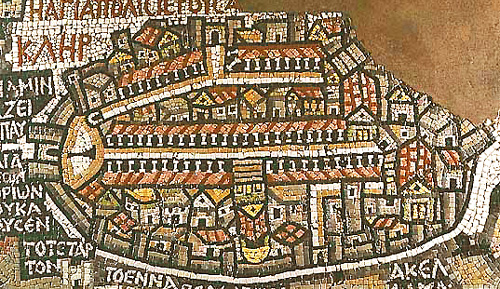
Many tour buses stop in at Madaba briefly to view the early Byzantine-era map in St. Georges Church that portrays the sacred geography of the Middle East from an aerial Christian perspective.  The Madaba Map is, however, but one of several early excavated mosaics.  Many of these are displayed in the Archaeological Park, while a small museum and grand mosaic floor are within the Church of the Apostles.  The central maze of streets provides a good walking area.  Madaba's visitor centre (open 8 a.m. to 5 p.m. and located on Abu Bakr as-Seddiq Street) is highlighted as a useful resource.

There are a number of circular day trips possible to both the South and the North.  For example, one could take in Mount Nebo, Bethany-Beyond-the-Jordan and the Dead Sea in one loop.

Mount Nebo is sacred to all three major monotheistic faiths.  According to tradition, it was from the summit of Mount Nebo, 10 kilometers northwest of Madaba, that Moses saw the Promised Land just before Joshua crossed the Jordan.  Many Jews and Christians believe that Moses is buried somewhere on Mount Nebo, though Muslims suggest that his body was carried across the river and placed in a tomb that now rests off the Jericho-Jerusalem highway.  Moses Memorial Church (5 a.m. to 7 p.m.) is an ancient shrine on the mountain.  It has some of the best mosaics in the region.  The views over the Dead Sea and the Jordan from this spot are spectacular.

Not far from Mount Nebo and just 8 kilometers north of the upper tip of the Dead Sea is Bethany-Beyond-the-Jordan, the place where John the Baptist lived and where he most likely baptized Jesus.  Appropriately, the Baptism Site itself is the focus for many pilgrims (open daily 8 a.m. to 1 hour before sunset).  But some of the most important work in contemporary Near Eastern archaeology has been taking place in the immediate vicinity, an area of Jordan that was an off-limits military zone until the 1994 peace treaty with Israel.  The cave and spring of John the Baptist, and attendant church ruins, can be reached at Tell Mar Elias after a short walk.  The hill  is named after the Biblical Elijah for it was here, according to tradition, that the prophet was taken up to heaven in a fiery chariot.  The Byzantine Rhotorius Monastery incorporates a black stone into its apse that commemorates this sacred fire.  It was the story of Elijah from a millennium earlier that inspired John the Baptist to take up residence on the same spot.  Tours can also incorporate a visit to the House of Mary the Egyptian.

Other sites with Biblical resonance lay a short drive to the south.  On a hill just above the village of Mukawir are the scant remains of the palace of Machaerus, where Salome is said to have danced for King Herod and where John the Baptist was beheaded.  According to Christian tradition John was buried in a now-marked cave near the hill, though Muslims contend that the head was taken to Damascus, and is now beneath the Great Mosque in that Syrian city.  Mukawir is located approximately one hour from Madaba, 20 kilometers down a side-road from Libb off the King's Highway.

Lot's Cave and Museum are located in the hills overlooking the southeastern part of the Dead Sea.  22 kilometers south of Karak, the cave is commonly regarded as the place where Abraham's nephew found refuge from the destruction of Sodom and Gomorrah.  Under excavation since 1988, Lot's Cave is a rich archaeological site that has offered up evidence of Bronze Age habitation, Nabataean pottery, Byzantine mosaics, and early Islamic-era worship.  The museum, billed as the "Lowest Museum On Earth", includes not only information about the cave but an introduction to the geology and history of the Jordan Valley and Dead Sea area.  The cave is a steep climb from the museum parking lot.  The guardian typically accompanies visitors to the site.  The birth of sons by Lot to his daughters has been commemorated for centuries at a cave-and-church complex in the hills above Safi.

The best-preserved Crusader-era castle in Jordan is at Karak.  The castle has seven different levels, some buried deep within the hill, and steps lead down into the vast rooms and corridors below ground.  Two or three hours could be devoted to exploring its various twists and turns.  The museum is open 8:30 to 4:30 a.m. daily except Tuesday.  Karak could be the focus for a day tour from Madaba or visited en route between Madaba and Petra.

It will probably be easier to access the Dead Sea for a float from Jordan than from Israel.  If we do this, we should stop somewhere near a place that supplies freshwater showers, since even a short dip in the lake leaves a layer of salt that is uncomfortable if not removed quickly.

Jerash may be the most interesting site north of Madaba.  Founded during Hellenistic times, it is the best-preserved Roman city in the region (admission JD 8).  It is a large site, and there is much to explore.  In regards to course theme, there is the Sacred Way that leads up to the Temple of Artemis.  Recent archaeological work has also revealed an 8th-century Umayyad mosque.  The search for the sacred should not divert us from enjoying the chariot racing that takes places five or six days a week.  Swedish, British and Jordanians have teamed up to produce a Roman Army And Chariots Experience that is part tourist schmaltz and part historic re-creation.


Other Activities

Perhaps we could schedule a free day in Madaba and organize a small-group tour of Amman for anyone who was interested.  This city of 2 million plus was once the Biblical capital of the Ammonites and the Roman city of Philadelphia before the Muslims of the Umayyad Dynasty used the same hills for their central palaces.  The Citadel, which includes some of the ruins of a Umayyad palace, is home to the Jordan Archaeological Museum.

The Dead Sea Panorama complex, completed in 2005, is off a branch road on way between Madaba and Hammamat Ma'in.

Shobak Castle was built by Kind Baldwin I in 1115 CE and thus was the first to be built by the Crusaders in Transjordan.  It fell to Saladin to 1189.  Although the view from 1300 meters above the barren surroundings makes it perhaps the best-situated castle in the country, it is much less well-preserved than Karak.  The potential highlight of any visit is the long passageway that runs beneath the chapel.  If you head right, this secret corridor brings you to the centre of the castle; if you head left you wind down a seemingly endless secret escape route before emerging far outside the castle at the bottom of the hill.

27 kilometers west of Jerash is the market town of Ajloun, which is dominated by the Arab castle that was built largely in response to Crusader entry into Transjordan.  One of Jordan's best government nature reserves is also located here.

In the hills west of Aljoun is another Tell Mar Elias, not to be confused with the one at Bethany-Beyond-the-Jordan.  This one is also named after the prophet Elijah, though in this case it commemorates not his fiery ascension into the heavens but his birthplace.  The ruins of a 7th-century church are at the summit; an annual festival and pilgrimage still actively honours him every July 21st.

Three kilometers south of Aljoun on the main road up from the Jordan Valley towards Jerash is the small town of Anjara.  Local tradition suggests the Jesus once stopped overnight at a cave near the town with Mary and some disciples en route to Jerash.  In 1971, Our Lady of the Mountain Shrine was built at the supposed site of his sermon.  The Vatican has since given its authorial endorsement and today Christian pilgrims visit the spot.


Possible Accommodations

I have included not only Madaba information but also other overnight possibilities for spots that could be reached as part of a day trip from Madaba.

Madaba

  • Mariam Hotel:  More than one guidebook highlights this hotel as the best place to stay in Madaba.


Other Places

  • Towers/Castle (Karak): Described as basic but the best of the inexpensive hotels.  Located approximately 100 meters north of the castle, it has some shared bathrooms, though the upper floor rooms have en-suite bathrooms and good valley views.

  • Karak Rest House:  An extravagantly decorated hotel by the castle with excellent valley views.

  • Olive Branch Resort (Jerash):  Some 7 kilometers from Jerash, just off the Aljoun road, the hotel has comfortable rooms and balconies with wonderful views.


Jordan Useful Links

Madaba Useful Links


D.  Petra and Wadi Rum

Introduction

Between the third century BCE and the first century CE, Petra was the key city of the Nabataean trading empire that served as a go-between connecting Rome and the East.  Now, the rock tombs and temples of Petra are considered as one of the seven new wonders of the world.  It would be good to have at least two full days at Petra to begin to explore it.  The stay in Wadi Musa could perhaps also be combined with an optional day trip into Wadi Rum.  There are passes at Petra that are valid for between one and four days.


Recommended Activities

Petra

Highlights of Petra include the Siq, the Treasury, the High Place of Sacrifice, the Monastery and the Royal Tombs.  The Lonely Planet recommends the experience of walking through the Siq in silence at 6 a.m. before the tour groups arrive.  There is also "Petra by Night," an after-dark guided excursion into the ancient city by candlelight.  Three local companies -- Petra Moon, La Beduina and Zaman Tours -- organize these walks.  They leave every Monday and Thursday at 8:30 p.m. from the Visitors' Centre (JD 12) and need to be booked directly or through a hotel.  The Wadi Muthlim offers an alternative entry into Petra.  It is a relatively easy path with excellent views but it takes at least two hours to reach the Nymphaeum in the centre of the ancient town.

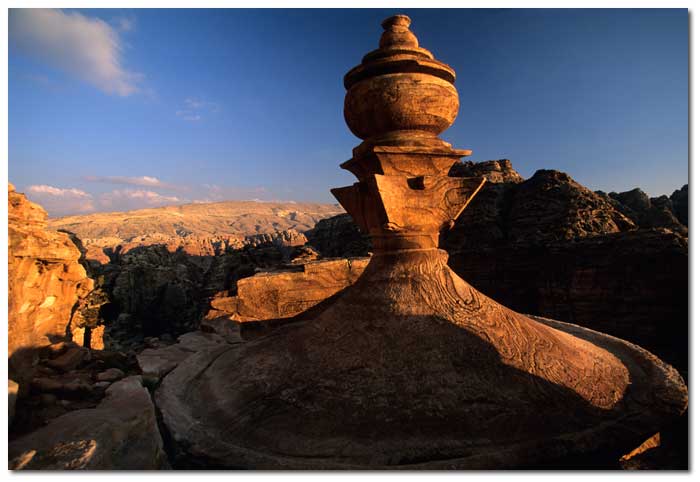
The High Place of Sacrifice is one of the most relevant spots in Petra for our course theme.  In ancient times, there were animal sacrifices here, probably in honour of Dushara, and perhaps also human sacrifice as well.  Nabataean religion may have involved ritual exposure of the dead.  The Monastery is well worth the challenging ascent.  It has a massive facade some 50 metres square carved from the mountain itself.  There is a holy spring two-thirds of the way up the hour-long stepped climb.

Wadi Rum

Wadi Rum has one of the most spectacular natural environments in the Middle East.  Most tourists visit the desert as part of a 4-wheel-drive trip arranged at the visitor centre.  The cost is typically in the range of JD 67/80, with an extra JD 30 for an overnight stay in a Bedouin camp.


Other Activities

Petra's northern suburb of Siq al-Berid is nicknamed "Little Petra."  It is well worth a visit and can serve as an escape from the crowds at the main site.

It is unlikely that even the most adventurous will want to climb Jebel Haroun.  This Petra-area mount, however, has one of the most interesting sacred stories of anywhere we will visit in the Middle East.  According to tradition, the tomb of Moses's brother Aaron is at the summit.  The site is sacred to Jews, Muslims, and Christians alike, and predominantly Muslim pilgrims still deck the Shrine of Haroun, only the latest of several structures to have been built on the peak, with colourful rags and threads.  This is in commemoration not only of Aaron, but also of the Prophet Muhammad, who is said to have climbed the mount on passing through Petra with his uncle on a journey from Mecca to Damascus.  The Christian guardian of the shrine was said to have prophesied that the 10-year-old boy would grow up to change the world.


Transportation

Mzied Atieq (mzidco@yahoo.com ) comes highly recommended as a guide by Lonely Planet.  He has a permanent camp-site in the deep desert.  Those listed below in the accommodations section also arrange tours of Wadi Rum.


Possible Accommodations

Petra

  • Amra Palace:  The Lonely Planet's starred mid-range selection, this 72-room hotel is describe as decent 3-star accommodations on a quiet backstreet in Wadi Musa.

  • Petra Moon:  A good low-budget hotel located only five minutes from the ticket gate into Petra.

  • Edom:  A three-star hotel that is guidebook recommended.

  • Silk Road:  A conveniently-located hotel that is frequently used by tour groups.

  • Ammareen Camp:  This Bedouin-style encampment is run by the Ammareen tribe and located near Siq al-Berid, or "Little Petra."

Wadi Rum

  • Mohammad Mutlak Camp:  Located in a spot overlooking Jebel Qattar.  Half board costs JD 30 per person and dinner often includes cooked lamb.

  • Sunset Camp:  This camp, 12 kilometers from Rum village, has been recommended by many Lonely Planet readers.  The chief guide is Mohammed Sabah Al-Zalabeh.

  • Bedouin Meditation Camp:  Budget-priced jeep trips and overnight camping organized by Zedane al-Zalabieh.

  • Aodeh Abdullah:  Recommended as a good-value tour that provides overnight camping.


Useful Links


E.  Aqaba And Other Jordan

Introduction

Aqaba is thought to be close to Ezion-Geber, the  port built by King Solomon, though the existence of that Biblical-era site has yet to be proved.  By the second century, BCE, the town was under the control of the Nabataeans.  It was one of the first significant places to fall to the Muslims on their northward advance in 630 CE, and thrived in the early Islamic period both as the home for an important madrasa and as a stage of the pilgrimage route to Mecca.

Aqaba is a potential location both as a transit point and as a potential mid-or-end-tour break for some waterside R & R.  I have included non-Aqaba-related Jordanian sites and activities that likely will not make our final cut in this section.  We should look at least consider these alternative stops on their merits, though, before eliminating them from our completed itinerary.  Are there any that catch your interest?


Recommended Activities

The Mamluk fort, set between palm trees on the beach, was built in the 16th century and is an interesting place to walk.

The Aqaba Archaeological Museum is located next to the fort in a building that also houses the tourist office -- the collection chronicles the history of Aqaba as a trading centre over the centuries.

We should decide on our diving policy before the trip but snorkelling equipment is also readily available.


Other Activities

Aqaba:  A company called Sinbad organizes cruises around the Gulf of Aqaba.  The Aqaba Turkish Baths are for males only, though women may visit by special appointment and get the whole place to themselves.

Other Jordan

The Jordanian government has recently established a series of nature reserves to protect native habitat and wildlife, and to encourage ecotourism.  In the Wadi Mujib Nature Reserve, for example, one can take a guided half-day trip down the Malaqi Trail (JD 53) that involves a hike up into the wadi, a descent through water, and rappell down a 18-metre waterfall.  The Dana Nature Reserve (JD 5) is but one of the options that combines hiking with the possibility of an overnight stay in cabins or guesthouses (the Dana Guest House has 9 rooms).  For more information, see Jordan's Royal Society For The Conservation Of Nature.

Umm Qais is in the extreme northwest corner of Jordan.  Attractions here include the ruins of the Roman city of Gadara.  The New Testament identifies this location as where Jesus cast demons into swine after crossing the Sea of Galilee.

The Eastern Desert likely lays beyond our range for this tour.  A day-long circle exploration of the so-called Desert Castles -- many of which were instead early Islamic retreats, hunting lodges and inns -- is recommended by a number of the guide books.  South of Safawi via a 35-minute ride across open country from the highway in Eastern Badia is the holy tree of Biqya'wiyya.  According to Islamic tradition, a young Muhammad rested under the pistachio here on the way between Mecca and Syria.  Pilgrims still visit the site today.


Possible Accommodations

  • Alcazar:  A friendly two-star hotel in the centre of Aqaba.

  • Aqaba Coral Bay:  A comfortable ocean-side hotel with 69 rooms at the Royal Diving Club some 17 kilometers south of Aqaba.


F.  Cairo And Area

Introduction

I am of two minds about Cairo.  On the one hand, I think it is probable that the heat and frenetic pace of Cairo will overwhelm students and instructors alike and thus wonder whether it may not be wise to push through Cairo as quickly as possible.  On the other hand, I like the idea of exposing the deep layers of Cairo's sacred history beneath the surface of the megalopolis.  Not sure that I have the knowledge or that students will have the patience for such an uncovering.  We will need to decide whether we want one stay or two stays in Cairo.  I prefer the former, unless Cairo becomes a necessary hub or transit point.  The pyramids and Egyptian Museum should not be over-emphasized to such an extent that the story of Jewish, Coptic and Muslim Cairo is ignored.


Recommended Activities

Around Cairo

There are several prominent ancient sites in the environs of Cairo besides the Great Pyramids.  Saqqara, Memphis and Dahshur all qualify here, though I have chosen to emphasize Saqqara here and list the other two locales as possibilities rather than as definite recommendations proceeding on the assumption that less sometimes can be more.

Saqqara is a vast necropolis that stretches over 7 square kilometers and covers every era of Egyptian civilization.  Its star attraction is the Step Pyramid of Dsojer, regarded as the oldest pyramid in the world, and the attendant Jubilee Courtyard.  But there is a wide array of monuments spaced some distance apart: other prototype pyramids, animal necropolises, deep burial chambers and cliff tombs.  The chamber of the Pyramid of Teti is decorated with stars and inscribed with sections of Pyramid Texts, one of the only places where these ancient funerary writings survive.  The Tomb of Mereruka includes magnificent wall paintings and a statue of Mereruka himself in front of a false door.  The Persian Tombs, extending down to a depth of 65 feet, date from a much later period in Egyptian history.  One of the most interesting of Saqqara complexes is the Serapeum, the catacombs of the Apis Bulls.  The underground corridors and lined with side chambers which once housed the mummified remains of these animals -- sacred to Ptah and Osiris -- in large granite sarcophagi.  Saqqara is open daily from 8 am to 5 pm.  Tickets for Saqqara are Egyptian pounds 50/25 for adults/students.  There also are extra tickets for those who wish to see more than 3 sites within.  I would recommend visiting Saqqara before we seethe Great Pyramids, and perhaps on a separate expedition.  A brief visit to the Red Pyramid and its interior followed by a much more extensive stop at Saqqara might be one possibility.

Ancient Egypt

The Great Pyramids on the outskirts of modern Cairo have long fascinated visitors.  King Tuthmosis IV undertook archaeological explorations at the site as early as 1400 BCE while the Greek historian Herodotus wrote with apparent wonder about those already-ancient monuments.  Contemporary tourists should prepare themselves for a frenetic onslaught.  Admission to the complex as a whole is Egyptians pounds 50/25 for adults/students, with extra charges for entry to each of the three Pyramids and to the Solar Barque Museum.  Even the slightly claustrophobic may find an exploration inside one of the Great Pyramids to be somewhat unsettling.  The Sphinx narrates a night-time Sound And Light Show that recounts the history of the site.

The Egyptian Museum is one of the great museums in the world.  Its star exhibits include the Tutankhamun Galleries, the Amarna Room, the Faiyum Portraits and the Royal Mummy Room, though there is enough here to keep one busy for several visits.  The museum is open daily from 8 a.m. to 5 p.m., though it is closed Fridays from 11:15 a.m. to 13:30 pm.  Museum tickets cost 20 Egyptian pounds, with an extra 40 pound charge for access to the Mummy Room.

Islamic Cairo

I like the idea of at least a full day devoted to an introduction to Islamic Cairo, preferably with a local Muslim guide as our group leader.  Following the capture of the Fort of Babylon by the armies of Amr Ibn El-As in 640 CE, Muslims founded Al-Fustat ("encampment"), the first Arab settlement in Egypt, near what is now the southern boundary of modern Cairo.  Any contemporary exploration of Islamic Cairo should begin in the area around the great medieval bazaar of Khan al-Khalili and the Al-Azhar Mosque.  Despite and indeed in part because of the potential culture shock involved, we should consider this neighbourhood as one possibility for our Cairo accommodations.

The Citadel, home to Egypt's rulers for some seven centuries, is one popular city tourist destination.  First occupied in 810, it was enclosed with fortifications by Saladin in 1176 to protect it from possible Crusader attack -- Saldin also carved the 270-foot-deep Joseph's Well to ensure a water supply.  A spiral staircase with observation windows winds down the outside of the well.  Open from 8 a.m. to 5 p.m. daily, the Citadel provides a good view over Cairo.  A number of structures are enclosed within the complex, including the beautiful cupolated Suleyman Pasha Mosque, built in the 16th century by an Ottoman governor.

And it is in the mosques of Cairo that one can perhaps best feel the power of Islam.  There are some mosques that out off-limits to non-Muslims, such as the El-Hussein Mosque, Cairo's holiest site, which is built on the site of the cemetery of the Fatimid caliphs and is said to contain the head of Hussein, the grandson of the Prophet Muhammad.  Mosques should not be visited at prayer time and tourists should both dress very conservatively and show deference.  But unlike in some other places countries, non-believers are welcome to visit Cairo mosques.

The mosque of El-Azhar was founded in CE 970 as the main mosque and madrasa soon after the arrival of the new Fatimid rulers from North Africa.  The university today is the most respected centre of learning in the Sunni Muslim world and the Sheikh of El-Azhar is regarded as Egypt's foremost religious authority.  Admission to the mosque costs 6 Egyptian pounds for tourists.

The Mosque of Amr Ibn El-As was the first mosque in Africa.  Founded in CE 642 and named after the the general who conquered Egypt, it was originally a simple rectangle of clay bricks.  It has continually been renovated and rebuilt, most recently with reinforced concrete in the 1970s, though it still retains its modest appearance.

The Mosque of Ibn Tulun, built in the mid-9th century by an Abbasid governor sent from Baghdad is the oldest original mosque in the city.

The Aqsunqur or Blue Mosque is one of the city's most impressive.  Built in the 14th century, it gained its interior coloured walls that gives it its present name in the mid-1600s.  The El-Mu-Ayyad or Red Mosque, meanwhile, was built between 1415 and 1420 by Sultan El-Mu'ayyad against the south wall of the city.

Perhaps Cairo's finest example of early Mamluk architecture is the Mosque of Sultan Hassan which was constructed in the 14th century beside what was then the fields of the Hippodrome.  Next door in faux imitation style is the much-more-recent Mosque of ar-Rifai.  Completed in 1912 and separated from Sultan Hassan only by a narrow street, it is probably of most interest as the burial place of both King Farouk, the last monarch of Egypt, and the final Shah of Iran, who was barred from his home country after the 1979 Islamic Revolution.

One final mosque of note is the El-Hakim Mosque.  The second largest Fatimid mosque after El-Azhar, it was completed in 1013 by the Caliph El-Hakim in 1013.  It was later abandoned, turned into first a market and later a museum, before being restored by Bahais in 1981.  The interior staircase leads to remains of Cairo's 12th-century ramparts.  The mosque is also of note in the El-Hakim destroyed the Church of the Holy Sepulchre in Jerusalem at the same time he was building El-Hakim.

The Museum of Islamic Art houses one of the world's best collections.  It is open daily from 9 a.m. to 4 p.m., though closed Fridays from 11 a.m. to 1 p.m.  (8 Egyptian pounds as admission).

I am intrigued by the Muslim cemeteries of Cairo.  The city has two great necropolises that represent 6.4% of Cairo's surface area and that serve as a barrier to eastward expansion.  They are nicknamed the "City of the Dead" in that some 179,000 residents live amongst mausoleums that are sometimes more impressive than the grandest of houses.  The Southern Cemetery has been Cairo's main burial ground since the Arab conquest.  It includes 26 monuments to ascetics, holy men and descendants of Muhammad, as well as 47 funerary monuments of emirs and sultans from the Ikhshidid, Fatimid, Mameluke and Ottoman periods.  The Barquq Mausoleum (Egyptian pounds 3) and the Imam as-Shafi'i Mausoleum (Egyptian pounds 3) -- the resting place for the founder of one of the four schools of Sunni jurisprudence -- are identified as two tombs of note.  Some guidebooks are even more effusive in their praise of the Northern Cemetery, with the Mosque of Qaitbey sometimes singled out as the city's most beautiful structure.  Cairo's cemeteries seem to serve as a link of sorts to ancient traditions of burial and kingship, as well as accentuating with the intermixing of today's living and yesterday's corpses both Egyptian attitudes to death and the contemporary social issues of Cairo.

Coptic and Jewish Cairo

Egypt was a very important centre in the development of early Christianity and Coptic Christians still comprise some 10 percent of the nation's population.  A number of old churches remain at the core of today's Coptic Cairo.  The Sitt Miriam, more commonly called the Hanging or Suspended Church, is built over top of the Water Gate of the Roman-era Babylon.  In the eleventh century it was the seat of the Patriarch, the head of the Coptic Church.  Coptic Mass is held here 8 a.m. to 11 a.m. on Friday and 9 a.m. to 11 a.m. Sunday.  The Church of St. Sergius has 3rd and 4th-century pillars within its walls.  According to tradition, it was erected above a cave where the Holy Family sheltered while escaping from King Herod and the Massacre of the Innocents.  The nearby Monastery and Church of St. George commemorates the Palestinian Roman Army conscript who was executed for defying Emperor Diocletian's edict outlawing Christianity in the early 4th century.  The attached convent is closed to tourists.  There is free admission to the Hanging Church; there is a cost of 10 Egyptian pounds for the rest of the churches.

Within the immediate vicinity of these churches is Ben-Ezra Synagogue, which is named after a 12th century rabbi who restored it.  The synagogue was built on the site of a 8th-century church -- St. Michael's -- which in itself was built on the ruins of an ancient synagogue said to have been founded by the prophet Jeremiah in the 6th century BCE at the time of the Babylonian's destruction of King Solomon's Temple in Jerusalem.  Jeremiah, in turn, is to have been reputed to pick the location as a worship site because it was the place where Moses had prayed for deliverance in the time of Pharaoh.  The near-by spring is said to have been where pharaoh's daughter found Moses in the reeds and where Mary drew water to bathe an infant Jesus.  Although those local legends cannot be corroborated, the synagogue has definitely proved its links to an ancient past.  In 1894, during renovations, a cache of some 250,000 papers, many dating back to the early Medieval era, was discovered behind the walls at Ben-Ezra.  The "Cairo Geniza" is one of scholars' most important sources of early Biblical documents.

Also within easy walking distance of the Coptic churches is the Coptic Museum (Egyptian pounds 40/20 for adults/students).  Located across from the Mari Girgis underground station. it is open daily from 9 a.m. to 4 p.m., except for Friday, when it closes between 11 a.m. and 1 p.m.

Farther afield, at Matariyya, a northeastern suburb of Cairo, is the Virgin's Tree, a twisted sycamore under which Mary is said to have rested with Jesus.  Note that the sycamore is also sacred to the ancient Egyptian goddess Hathor.

One should not imagine the sacred sites of Coptic Christianity as merely offering echoes of the ancient past.  The Coptic Church at Zeitoun north of Cairo has  become a Marian pilgrimage spot for Christians and Muslims alike after a series of supposed apparitions of the Virgin above the church between 1968 and 1971.  In Cairo itself, the Church of St. Simeon the Tanner has also become a pilgrim site.  Completed in 1994 , the church commemorates a 10th-century CE mystic who prayed to make the Muqattam Hills move at the request of the Fatimid caliph.  It seats 5,000 people and is ringed with Biblical scenes carved into the Muqattam hill-side amidst the Coptic neighborhood that serves as home to the thousands of Christian garbage-collectors and recyclers known as the "zabbaleen."  The Lonely Planet recommends Ibrahim Morgan as an excellent guide for those wishing to visit the church ( morgan_@yahoo.com  ).


Other Activities

Memphis, the long-time capital of ancient Egypt, is located on the left bank of the Nile approximately 30 kilometers south of Cairo.  It was at the meeting point of the Two Lands of Upper and Lower Egypt and played a prominent role in the civilization's history.  Successive floods and invasions have wrought much devastation; a visit to Memphis does not offer much tangible evidence that this once was the centre of a world empire.  A giant statue of Ramesses II is one prominent monument.  There also is an Open-Air Museum that displays the remains of the embalming tables used in the Sanctuary of Ptah for the Apis Bulls.

Like Saqqara, Dahshur (64 kilometers south of Cairo) is a prominent early pyramid ground less frequented by tourists than the complex at Giza.  The Bent Pyramid and the Red Pyramid are the earliest examples of "true" pyramids since, unlike Djoser's Pyramid, they are not stepped.  The Bent Pyramid still has much of its limestone casing.  The Red Pyramid was originally 722 feet square and 325 feet high; it is open to visitors from the north side and exploring its interior is recommended.

Cairo's Whirling Dervishes perform every Wednesday and Saturday starting at 9 p.m. at the Al-Ghouri Complex in Islamic Cairo .


Tour Guides

  • Egypt Tours:  This is recommended in Lonely Planet as a good way to see the Cairo-era pyramids.  A day-long trip to the Giza Pyramids, Memphis and Saqqara costs US $23.50 plus entrance fees.  There is also an Islamic and Christian Cairo day trip and a two-day trip from Cairo to St. Catherines for $US 105 that includes a climb of Mt. Sinai.  This company may well bear further investigation.


Possible Accommodations

If possible, it would be great to stay in Coptic Cairo or in medieval Islamic Cairo.

  • Osiris Hotel:  This mid-range hotel in Bab al-Luq is recommended by Lonely Planet.

  • *** Al-Hussein Hotel:  56 rooms, 28 with air conditioning and attached bathrooms.  Comfortable rooms in medieval Cairo, though being close to Khan al-Khalili the noise level is high.

  • Pension Roma:  32 rooms.  Five of the rooms have attached bathrooms.  Lonely Planet-recommended as one of Cairo's great bargains (Egyptian pounds 53/91).


Useful Links

Egypt

Cairo


G.  Aswan To Luxor

Introduction

Aswan is located 215 kilometers south of Luxor and 900 kilometers south of Cairo.  From Old Kingdom times, it marked Egypt's southern border and served as a garrison town to both protect against and to extend Egyptian control into Nubia.  With a modern-day population of some 220,000 people, including a significant Nubian community, it has a more relaxed atmosphere than some places further to the north.  For our purposes, it would serve most importantly as a departure point for a Nile River journey.


Recommended Activities

Elephantine Island is the oldest inhabited part of Aswan -- it once served as a cult centre for the ram-headed Khnum, a creator of mankind and sacred controller of the Nile flood.  An ancient Nilometer is just south of the so-so Aswan Museum (Egyptian pounds 25/15 for adults/students).  There also are two small Nubian villages that are interesting to explore.  The island can be reached by felucca or by regular ferry opposite the Thomas Cook office (women up front; men at the back).

A giant unfinished obelisk from the New Kingdom era lies in the ancient granite quarry just to the south of Aswan.

One of Egypt's more interesting Muslim burial places, the Fatimid Cemetery, is on the east side of the Nile.  Over on the west side, in the hills north of Kitcher's Island, are the rock-carved Tombs of the Nobles.  Many of these Old and Middle Kingdom tombs are decorated with wall paintings of everyday life.

The exterior walls of some of the colourful contemporary houses of Aswan, meanwhile, feature images commemorating the inhabitants' hajj pilgrimage to Mecca.

There are several historic sites on the river between Aswan and Luxor.  Stops can be arranged for any of these if traveling by felucca; larger cruises typically have a set itinerary and can only dock at the most prominent locales.

Kom Ombo is the first of these places on the trip down-Nile from Aswan.  At a strategic point controlling access to the wadis into the gold mining regions of the desert, it has been occupied since prehistoric times.  The temple there is the only double temple in Egypt (Egyptian pounds 25/15).

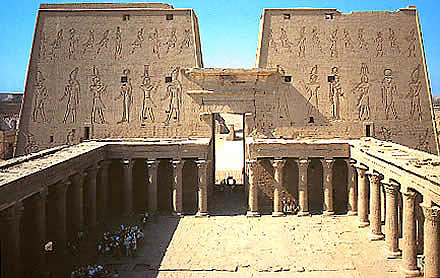
Edfu, at the approximate half-way point between Aswan and Luxor, is a possible stopping point for a river trip.  According to ancient Egyptian belief, this was a spot where Horus fought a pivotal battle against his usurper uncle Seth, the murderer of Horus's father and Seth's brother Osiris.  The Temple of Horus at Edfu (Egyptian pounds 40/20) is an exceedingly well-preserved Graeco-Roman era structure.  The remains of Horus's birth house rests to the southwest of the temple.


Other Activities

Most Aswan tourist itineraries include a visit to Agilika Island, the site of the relocated Temple of Isis, and a day trip further south to Abu Simbel.  The Temple of Isis was once on the small island of Philae, a sacred spot where the goddess was said to reside to be close to her husband Osiris (the neighbouring island of Biga was considered part of the god's mummified body).  Only temple priests and servants were allowed on Philae.  The temple was moved by UNESCO because the high dam of Aswan submerged Isis's isle.  Abu Simbel, the famous rock temple to Osiris/Ramesses II is 280 kilometers south of Aswan across a stretch of desert.  It also was rescued by UNESCO in an engineering feet to rival the building of the dam itself.  Although I am not opposed to visiting either the Temple of Isis or Abu Simbel, I do not feel obligated to support the megalomania of either Ramesses or Nasser and think that this might be one opportunity to do a little paring down of an already-overwhelming itinerary.

The Monastery of St. Simeon is in the desert to the west of Aswan.  It was once one of the most important Coptic centres in Egypt -- home to some 300 monks -- before being abandoned in the 12th century after being besieged by forces under the command of Saladin.  It remains deserted today, though there is a charge (Egyptian pounds 8).  It can be reached by crossing the Nile in a felucca and continuing on by foot or camel (20-25 Egyptian pounds roundtrip).

A Nile trip could be extended north of Edfu to El-Kab.  The ancient Egyptian city of Nekheb (the Greeks called it Eileithyiapolis), this is one of the oldest settlements in Egypt.  Associated with the vulture-goddess Nekhbet who was represented as part of the symbol on the pharaonic headdress, the town declined in importance when the capital was moved to Memphis.  A cave temple in the mountainside is dedicated to Nekhbet in her form as lioness; deeper along this wadi into the interior is "Vulture Rock," which is covered with drawings and inscriptions dating back to prehistory.

The northern terminus of smaller Nile cruises is Esna, 54 kilometers south of Luxor.  Its most significant architectural remain is the Temple of Khnum, though this is now in ruins.


Transportation

Egyptian civilization and the Nile River are so connected that one cannot make sense of the first without a proper appreciation for the latter.  And what better way to gain some type of connection with the river than to spend a few days upon it?  And traveling by sail, though slower than modern cruise liners, certainly offers a more meaningful vicarious connection to the rhythms of the past than does the Egyptian equivalent of the "Love Boat."

Until recently, small feluccas were the only sail-powered option on the Nile, but there are an ever-increasing number of more upscale dahabiyyas.  Both the feluccas and the dahabiyyas have a much more flexible schedule than the cruise liners, and they can stop at a larger selection of sites since they do not need special docking facilities.

Feluccas

A trip down the Nile on a felucca is a unique experience.  The most popular trips are to Kom Ombo (two days) or Edfu (three or four days), though some travelers choose to go as far north as Esna.  There are some 3400 feluccas in Aswan and thus the competition amongst boatsmen is fierce.  Feluccas can carry between 6 and 8 passengers.  The typical fare exclusive of food is 40 Egyptian pounds per person to Kom Ombo, 70 Egyptian pounds per person to Edfu and 90 Egyptian pounds per person to Esna.  Food, then, is an added cost, as is 5 to 10 Egyptian pounds per person for the captain to arrange police registration.  The boatmen do the cooking and sleep aboard.  There are no toilets, so passengers need to either go overboard or to find somewhere on shore.

Dahabiyyas

I am game to try felucca.  I do, however, worry about the excessive heat and sun of a southern Egyptian summer, particularly if we move onto the Nile within a few days of our arrival in the Middle East.  I worry also about the spartan conditions and how some students might adapt.  I think we should also investigate the price differential with dahabiyyas before committing to feluccas.  And if we do opt for the latter, I might suggest a one night/ two day short expedition.

Listed below are a selection of dahabiyyas, though several of these are clearly targeting a more up-scale market.  What are the chances of finding a great deal given that we will be visiting during the off-season?

  • ***  Royal Cleopatra Dahabia Charters:  If two boats could be rented and students alternate between cabin and deck sleeping on different nights, this might be an affordable option.

  • ***  Belle Epoque Dahabiyyas: Six different dahabiyyas.  Prices available upon request.  The set itineraries include a week-long trip from Aswan to Luxor including two full days exploring Luxor and the West Bank.  This may be worth some inquiries.

  • El Nil:  A luxury replica of a 19th-century dahbiyya.  Room for 20 passengers in 10 cabins.  The same owners have 3 other boats.

  • Spring Tours Egypt:

Other Boats

  • M/S Beau Soleil:  A more-reasonably priced cruiser than some of the competition.  A guidebook lists a per person charge as from US $95 per night.

  • M/S Sudan:  A steam ship which was built as part of Thomas Cook's fleet in the late nineteenth century and which was once owned by King Fouad.  A 3-night cruise regularly costs 1390 Euros for a double.

  • M/S Florence:  A five-star cruiser with 75 cabins.


Possible Accommodations

Most hotels are in Aswan itself on the east side of the Nile.  An alternative would be to stay on Elephantine Island and thus gain easy access to the Nubian village.

  • Old Cataract Hotel:  This is one of the grandest old luxury hotels in Egypt.  It was here where Agatha Christie wrote some of her mystery Death on the Nile.  We should consider splurging on the Cataract if we only stay in Aswan for one night -- perhaps even if we spend two nights -- if we can get a great deal.

  • Keylany Hotel:  A guidebook-recommended option.

  • Pyramisa Isis Island Hotel:  Part of a national Egyptian chain.  Accessed via boat.

  • Sara Hotel:  A three-star hotel on a cliff above the First Cataract.


H.  Luxor

Introduction

Modern-day Luxor was the site of ancient Thebes (Waset), which served as the capital of Egypt for most of the Middle Kingdom and New Kingdom periods.  Sacred temples to Amun-Re were on the east side of the Nile; the West Bank was transformed into a vast pharaonic burial ground.  We cannot begin to see all of Luxor and the West Bank during our time in Egypt but should decide how many nights we should spend there are whether it can be used as a base for a day trip northward.  Usually itineraries involving Luxor have it as the final destination in a southern tour before the return trip to Cairo.  We should not rule out the possibility of using it as a staging point for a river journey north and/or south, and should also consider the possibility of an exit towards Hurghada (and then to the Sinai by water) rather than a return to Cairo as we ponder alternative itineraries.


Recommended Activities

Luxor is today a large town of some 150,000 people that is organized around the tourist trade.  Luxor Temple, completed by Amenhotep III during the New Kingdom era, remained coherent in design up through the Classical period.  Situated in the middle of town, it is open during the summer until 10 p.m.  (Egyptian pounds 10).

The Luxor Museum (Egyptian pounds 75/35 [?] for adults/students) is half-way between Luxor Temple and the sprawling complex at Karnak.  It is open 10 a.m. to Noon and 5 p.m. to 10 p.m.  It is complemented by the Mummification Museum (Egyptian pounds 40/20), which includes a mummified cat and ram amongst other exhibits.

The Temple of Karnak , located three kilometers northeast of Luxor, rivals the Great Pyramids as ancient Egypt's most important site.  Here was the Great Temple of Amun-Re, where Amun was said to have created the universe.  Pharaoh after pharaoh added to the architecture here, both to honour the god who inhabited the temple's inner sanctum and to legitimate pharaonic power.  Some 80,000 priests lived here by the time of Ramesses III.  Karnak and Luxor are linked together by a long sacred pathway; in ancient Egypt the sites were also symbolically connected by the annual Feast of Opet that saw the voyage of Amun-Re from Karnek to its partner temple.  Karnak is open daily from 6 a.m. to 6:30 p.m. (Egyptian pounds 50/25).  There is also an open-air museum that can be reached through the north gate of the first court of the temple.  Guidebooks recommend the night-time Sound and Light Show at Karnak as a tourist extravaganza that effectively introduces the long history of the great temple.

The Valley of the Kings on the West Bank is most famous necropolis in Egypt.  The Royal Tombs here are open on a rotating basis in an effort to limit deterioration.  Any 12 or so are open at one time; a ticket gains one access to any 3 of these.  There are extravagant extra charges for entry to the tomb of Tutankhamen.  The Valley of the Kings is two kilometers north of the ticket office.

Likewise, only a few of the 80 tombs of the Valley of the Queens at the southern edge of the necropolis are open at one time.  The princes' tombs of Amenhikopeshef and Khaemwese are highlighted in some guidebooks.  The most famous tomb is that of Queen Nefertari, which was reopened after extensive renovation in 1995.  Visitor numbers are tightly controlled.  If the tomb is accessible at all, it will only be so with advanced reservation and a payment in the area of 100 Egyptian pounds per head.

Amidst the West Bank's vast world of the dead it is not surprising that the Tombs of the Nobles (the Shekh Abd al-Qurna Tombs) are often overlooked.  The necropolis at Qurna, however, includes some of the very best Egyptian wall paintings.  One ticket (approximately 6 Egyptian pounds) gains access to 2-3 tombs.

Moving down the Egyptian class hierarchy, the archaeological remains at Deir El-Medina offer a unique glimpse into the lives of non-elite Egyptians.  The site for much recent excavation, Deir El-Medina was the town in which the necropolis-building artisans resided in state-enforced seclusion.  The Tomb of Sennedjem and the Tomb of Inherkhau are particularly interesting.

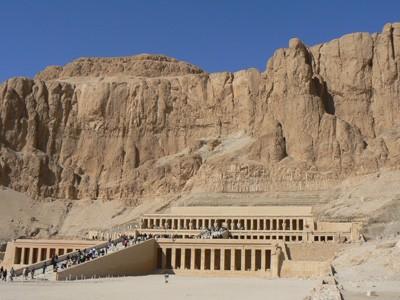
The Temple of Hatshepsut is cut into the cliff at Deir El-Bahri some 2 kilometers northeast of the West Bank ticket kiosk.  Designed by her chief advisor Senenmet and defaced after her death by those pharaohs who wished to erase her memory, the temple was later transformed into a monastery (the contemporary name Deir al-Bahri can be translated as "Northern Monastery").  It is open from 6 a.m. to 5 p.m. daily.  Deir El-Bahri is one of the hottest places on earth; a very early morning visit is suggested to avoid the crowds and the worst of the heat, and to see the reliefs in low sunlight.

The Ramesseum is the funerary complex for Ramesses the Great.  The head and shoulders of a once-enormous statue of the famous pharaoh stands in a courtyard; it was this monument that inspired the British poet to write "Ozymandias."  Despite being in ruins, the Ramesseum is well worth visiting, with the Osiride Columns amongst the remains.  It is located approximately 1 kilometer northeast of the West Bank ticket kiosk and is open 7 a.m. to 5 p.m. daily (Egyptian pounds 6).

The Colossi of Memnon mesmerized the Greeks and Romans of the Classical Era -- this monumental portrayal of Amenhotep III once stood before the entrance to his large mortuary temple.


Other Activities

The oldest mosque in Luxor, the El-Mekashkesh Mosque, contains the 10th-century Muslim missionary who is said to have been a monk before he converted and came to Upper Egypt to spread the teachings of Islam.  It has long been a pilgrimage site and miraculous powers are attributed to the saint.


Transportation

Tourists are usually required to travel out of Luxor in a police convoy.  There are 10 checkpoints between Luxor and Hurghada on the coast and 9 between Luxor and Aswan.  Typically there's only one convoy a day and charges apply.

Most tourists cross to the West Bank by bus or taxi via the bridge, about 7 kilometers south of town, though there is also boat transit.

Bicycles can be rented for approximately 10 to 15 Egyptian pounds from most hotels and can be a convenient way to get around both the East and West Banks.

The Abela Egypt Sleeping Train leaves Luxor at 9 p.m. and 9:30 p.m. daily, arriving in Cairo at 5:45 a.m. and 6:45 a.m. ($US 60/80 in a double/single cabin).  The price includes a basic dinner and breakfast but there are no student discounts.


Tour Companies


Possible Accommodations

Luxor

  • Nour al-Balad:  Located in the village of Kom Lolah and recommended by Lonely Planet.

  • New Pola Hotel:  81 rooms.  In a good location for walking to Luxor Temple.

West Bank

  • Marsam Hotel:  23 rooms.  Built in the 1920s for archaeologists, 13 of the rooms are in the original mud-brick building with 10 more in a concrete addition.  Recently renovated with clean but shared bathrooms.

  • Al-Gezira Hotel:  11 rooms.  A small two-storey hotel with a rooftop restaurant.  Clean rooms with bathrooms and fans.

  • Beit Sabee:


I.  North Of Luxor

Introduction

The area north of Luxor has been difficult to access since the Islamist violence of the 1990s.  The region, however, includes some of ancient Egypt's most important sites, including Abydos, the sacred cult centre for Osiris, and Tell El-Amarna, which has the ruins of Akhenaten's short-lived capital.  Guidebooks describe the region as largely off-limits for overnight stays for foreigners.  We should at least determine whether a visit to El-Amarna is possible.


Recommended Activities

Dendara, located approximately 60 kilometers north of Luxor, was where Hathor was said to have given birth to a son by Horus.  The remarkably-well-preserved Graeco-Roman era Temple of Hathor lay buried under the sand for centuries.  The ceiling charts the course of the sun and moon and retells the story of the resurrection of Osiris.  A large relief on the exterior back wall shows Cleopatra and Caesarion -- her son by Julius Caesar -- dedicating an offering to the goddess.  An annual festival celebrated the divine union of Hathor and Horus.  The temple statue of the goddess was transported by barque up-river to Edfu to be reunited with her consort.

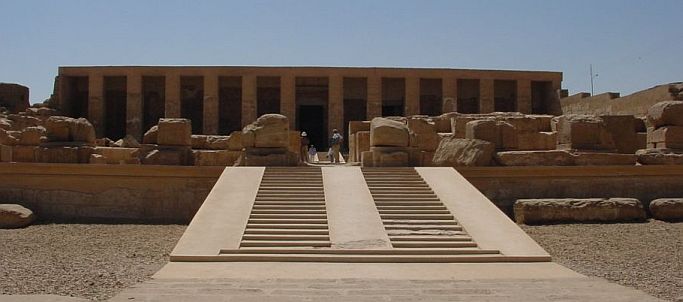
Abydos was arguably the most sacred site of all in ancient Egypt.  It was here where the backbone of Osiris was buried and where many early pharaohs also sought to be entombed.  It remained a pilgrimage site throughout successive eras.  Little remains of the ancient town today, which lies beneath the village of Beni Mansur, though the atmosphere of the ancient grounds still resonates.  The Osireion, the structure of huge blocks built by Seti I behind his temple was reputed to be the tomb of Osiris.  The artificial underground island may have contained a sarcophagus and Canopic jars reserved for the god.


Other Activities

Tell El-Amarna may not be accessible at all.  It it can be reached, a visit is only practical with private transportation provided.  The site is both large and desolate, with many of the tombs in disrepair.  Guidebooks do speak of the the power of the place.  It is open 8 am to 4 pm daily (Egyptian pounds 6).

At Deir Durunka, some 10 kilometers south of Assiut, is a cliff-side monastery on a spot where the Holy Family is said to have stayed.  This is a region in which Coptic Christianity is very deeply rooted.

The ancient site of Khmun (Hermopolis) is north of El-Amarna (8 kilometers north of Mallawi).  The sacred city of Thoth, it was the center for one of the four major competing Egyptian creation myths.  Two monumental baboons stand at the entrance to a ruined complex redesigned by Amenhotep III.  The most interesting site at Hermopolis is the large necropolis, Tuna el-Jebel, that is to the southwest of the former city.  The underground maze here was once filled with thousands of mummified baboons and ibises.

Beni Hassan, even further north than Hermopolis, has at least a couple of sites of interest.  The Cave of Artemis, in a wadi some 3 kilometers to the southwest of Beni Hassan, was carved out of the rock in honour of the lion-goddess Pakhet during the reign of Hatshepsut.  The mosque in the village of Sheikh Abada was built on the reputed home of Mary the Copt, a concubine of Muhammad.  Here is one place in which the Christian and Muslim sacred stories overlap in a fascinating way.


Transportation

Dendara and Abydos are most easily visited from Luxor.  Day trips to Dendara and Abydor leave with the convoy north from Luxor at 8 a.m. and branches off at Qena with an escort.  There is also a 2 p.m. trip to Dendara.  The convoy returns to Luxor at 5:30 p.m.  Cruises north of Luxor are also beginning to appear again.


J.  Eastern Desert And Sinai

Introduction

Egypt east of Cairo has featured prominently in the history of monotheism.  Most obviously, this is the sacred geography of the Exodus story, including the Burning Bush, the parting of the Red Sea, the wandering in the wilderness, and the receiving of the Ten Commandments.  But this is also the landscape in which the Christian monastic tradition was forged.


Recommended Activities

St. Catherine's Monastery was founded in 527 CE by the Byzantine Emperor Justinian on the site where Moses was said to have seen the Burning Bush, replacing an earlier church established by Helena, the mother of Constantine the Great.  It only gained its present name several centuries later when, according to tradition, the intact body of the Alexandrian martyr St. Catherine was found by monks nearby.  It is still a functioning monastery and thus visiting hours for tourists are limited (9:00 a.m. to Noon and closed on Friday and Sunday is the reference I found) and some of the most sacred parts of the monastery are off-limits (eg. Chapel of the Burning Bush).  The monastery is located some 90 kilometers west of Nuweiba.  St. Catherine's Village is also known as El-Milga.  Highlights of the monastery include the Basilica of the Transfiguration, the Well of Moses, A Burning Bush off-shoot, and a mosque within the monastery chapel dedicated in the early twelfth century in an attempt to appease local Muslim rulers.  The superb icon collection is in the monastery museum above the Well of Moses (adult/student Egyptian pounds 25/10).

Mount Sinai, it is claimed, is the Biblical Mount Horeb where Moses received the Ten Commandments.  A climb to the summit is a strongly recommended part of any visit to St. Catherine's, though a 3 a.m. start with flashlight is suggested for those who would attempt the hike in the summer.  There are two paths to the top.  Only those who either have been particularly bad or who are particularly concerned about following in the reputed footsteps of Moses should opt for the torturous 3700 Steps Of Repentance.  The less repentant should instead take the path on the way up and the steps on the way down.  Either route involves a three-hour ascent.  Approximately 750 steps below the summit is Elijah's Basin, the spot where the prophet Elijah is said to have heard the voice of God and where the elders who accompanied Moses stopped leaving him to ascend to the top alone.  Those who want to spend their night on the mountain are asked to sleep here.  A small modern Chapel of the Holy Trinity, built on the ruins of a 4th or 5th-century shrine is at the summit, as is a 12th-century mosque and the cave where Moses is said to have spent the 40 days.

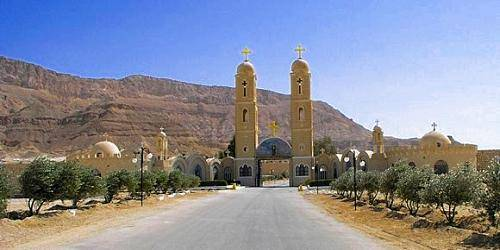
The Monastery of St. Anthony (361-63 CE) is the oldest monastery in Egypt.  It was built on the grave of Saint Anthony the Great, a third century mystic and founder of the Desert Fathers who sold all his worldly goods and retreated into the desert.  300 meters above the monastery on a cliff is the cave in which Anthony is said to have lived his last four decades.  One needs to squeeze through a narrow tunnel to get to the small chapel inside the cave.  The monastery is 47 kilometers west of Zafarana and can be reached from Cairo, Suez or Hurghada.  Organized tours run from Cairo and Hurghada.


Other Activities

St. Paul of Alexandria is said to have pre-dated Anthony, though he may indeed be a legendary person.  The Monastery of St. Paul is 80 kilometers southeast of St. Anthony's via difficult mountain roads.

Charting and looking for archaeological evidence of the Exodus in the Sinai has long been a preoccupation for amateurs and professionals alike.  Legend has it that Hamman Fara'un is the spot that the Egyptian army was drowned when the Red Sea parted -- the spirit of the pharaoh is said to haunt the spot.  Ain Musa or the Spring of Moses, to the southeast of the Ahmed Hamdi Tunnel, which runs under the Suez Canal, is commemorated as the place Moses transformed a bitter spring into one with sweet water by throwing a branch into it in at God's command.  Feiran Oasis, some 60 kilometers west of St. Catherine's Monastery, is, by tradition, not only the last place the Israelites rested before reaching Mount Sinai but also the site for Joshua's defeat of the Amalekites (Exodus 17).

Another popular Sinai excursion is to Sarabit el-Khadim and the nearby Mount Sarabit.  The Temple of Hathor stands among the turquoise mines on the mountain.


Possible Accommodations

St. Catherine's can be reached from Cairo, from Hurghada or from Aqaba.  How we approach it will depend on how it most conveniently fits into our itinerary.  If we want to climb Mt. Sinai, we will need to spend at least one night in the area.  The coastal towns of Nuweiba and Dahab (85 kilometers south of Nuweiba) are possibilities here, particularly if we move on to Aqaba immediately afterwards, though I would prefer to stay in St. Catherine's Village if possible.

St. Catherine's

  • St. Catherine Guesthouse:  Next to the monastery and recommended as the most interesting place to stay as the monastery's auberge.  S/D half board $US 32/55.  40 rooms.  Tel (069) 3470 353; Fax (069) 3470 353

  • St. Catherine Tourist Village (Wadi el-Raha): Comfortable chalets spread over a wide area.

  • El-Milga Bedouin Camp:

Nuweiba

  • Nuweiba Basata:  26 rooms.  A popular hotel and camp 23 kilometers north of Nuweiba.  Mud and bamboo huts with good snorkeling.

  • Nuweiba Habiba Village: 21 rooms.  A tradition hotel village built on the beachside.  Most rooms have air conditioning and private bathroom; wooden cabins have fans.

Dahab

  • Jasmine Hotel:  An inexpensive alternative to the many camps.  17 rooms.

  • Dahab Bishbishi Camp:  40 rooms.  A series of beachside bamboo huts.  Some have fans but no air conditioning.


Useful Links


K.  Other Egypt

Deir al-Muharraq, the Burnt Monastery, is on a site where many Coptics believe that Mary and Jesus lived in a cave for half a year after their flight from Herod.  Egyptian Christians also claim that the church there is the world's first (circa 60 CE).  Deir Al-Muharraq remains a place of pilgrimage and somewhere that deep Coptic traditions can still be experienced.

The south Red Sea port of Al-Quesir (population 20,500) is described by guidebooks as a delightful town.  It was once a major departure point for Hajj pilgrims and its main architectural feature in a 16th-century Ottoman fortress.  80 kilometers south of Safaga, it is linked to Edfu by a desert road that cuts 230 kilometers across the Eastern desert.


III. TRAVEL AGENTS, TOURS AND TOUR GUIDES

Tours


Egypt

There are many English-speaking guides and interpreters attached to the Egyptian Department of Antiquities.  Guides are assigned to organized tour groups by a local tourist agency acting on behalf of the foreign tour operator.  The assigned guides have the necessary permits for visiting Upper and Lower Egypt.  Only official guides are permitted to give presentations as the sites are visited.

Non-Egyptians who offer commentary to tour groups may be fined or even expelled from the country, though special authorization can sometimes be arranged.

  • Spring Tours:  A Nile Cruise tour operator.

  • Egypt Panorama Tours:  Described in a guidebook as one of the best agencies in Egypt.

  • Jolley's Travels And Tours:  This company is highly recommended by guidebooks for its budget day trips, though its web-site emphasizes travel packages.

  • Al-Nada Travel Services:  Based in Luxor but oriented towards travel packages rather than day touring in the local area.

  • Egypt Tours:  This is recommended in Lonely Planet as a good way to see the Cairo-era pyramids.  A day-long trip to the Giza Pyramids, Memphis and Saqqare costs US $23.50 plus entrance fees.  There is also an Islamic and Christian Cairo day trip and a two-day trip from Cairo to St. Catherines for $US 105 that includes a climb of Mt. Sinai.  This company may well bear further investigation.


Jordan

There are a number of guidebook-recommended tour companies that offer comprehensive tours around Jordan.  These include:

  • International Traders: Located in Amman (06-5607075) and Aqaba.

  • Petra Moon:  Located in Wadi Musa.

There are also tours organized by budget hotels in Amman and Madaba.


Israel

  • Tours In English:  This is a guidebook-recommended company that offers tours of Jerusalem and the West Bank.

  • Alternative Tourism Group:  Offers, amongst other activities and services, day tours of Hebron and Bethlehem (every Tuesday, 8 a.m. to 6 p.m.).

  • Palestinian Association For Cultural Exchange: Offers one-day and longer tours of Nablus, Hebron, Qalqilya and elsewhere, supports local cooperatives, and can arrange lectures.

  • Holy Land Trust:  An organization, based in Bethlehem, that sponsors the annual Palestine Summer Encounter and can also arrange tours of the Occupied Territories.


IV.  TRANSPORTATION INFORMATION

Ferries

Arab Bridge Maritime Company: There is a sea link between Aqaba and Nuweiba, seventy kilometers to the southwest on Egypt's Sinai coast.  Both a ferry ($ US 60 -- 3 hours) and a catamaran ($US 70 -- 1 hour) make at least one crossing a day.


Buses

Israel

Mazada Tours: This Israeli tour company organizes tours throughout the region and is identified as providing convenient bus service to Cairo.  Buses leave Jerusalem at 9 am on Sunday, Monday and Thursday from the Pearl Hotel.  There also is service in the opposite direction from Cairo.  Mazada is represented in Cairo by Misr Travel (fax 02-335-5470).

Most long-distance bus routes in Israel are run by the Egged company.


Jordan

The most important national bus company in Jordan is JETT, which runs air-conditioned buses between Amman and Aqaba, the King Hussein Bridge and Petra.

Trust International Transport has bus services from Amman to Nazareth (JD 20), Haifa (JD 20) and Tel Aviv (JD 25) daily except Saturday.


Egypt

Hebron Tours: Buses for Jerusalem leave from the Giza Sheraton at 5 am.

There is a Superjet service to Amman (US $95) departing from Al-Mazar Garage in Cairo on Saturday, Sunday, Tuesday and Friday at 11 pm.

There is daily East Delta Bus Company to Aqaba (US $50) departing in the evening.


Trains


Border Crossings And Visas

There are three border crossings between Jordan and Israel.  The King Hussein/Allenby Bridge Crossing, sixteen kilometers east of Jericho, offers the most direct route between Amman and Jerusalem.  From East Jerusalem, one can take a taxi or minibus to the border and then pick up transportation on to Amman.  It is open 8 a.m. to 2:30 p.m. Sunday to Thursday and until 11:45 p.m. on Friday and Saturday.  The Sadi Araba border crossing, also known as the Southern Crossing, is down a side road off the Wada Araba highway 4 kilometers from Eliat and 10 kilometers north of Aqaba.  It is open 6:30 to 10 p.m. Sunday to Thursday and 8 am to 8 p.m. on Friday and Saturday.  There is a JD 5 departure tax.  The third crossing, near Beth Shean, is much less convenient.

There are two official border crossings between Egypt and Israel: Rafah and Taba.  Taba may be the only option.  Travellers pay a 69 NIS departure tax to leave Israel and around 20 Egyptian pounds to enter Egypt.


V.  INSTRUCTOR INFORMATION


VI.  STUDENT INFORMATION

International Student Identity Cards : Students should strongly consider acquiring an International Student Identity Card (ISIC).  This is the most widely recognized form of student and ID and qualifies the holder to half-price admission to museums and ancient sites.  They are only valid for under 26s.  The card is also available for $22 from STA Travel ( http://www.statravel.com/  ) , the biggest student travel agency in the world.


free
web stats